Your AI Pilot Did Not Fail. Nobody Owned the Workflow.
AI initiatives stall not because the model is incapable but because nobody owns the full path from trigger to action to verification to recovery, so a dead dependency reads as a clean zero.
One morning a system of mine filed a report I had learned to like: nothing to do. Zero items flagged. Zero actions needed. A clean, quiet, reassuring zero.
The zero was a lie. The lookup that fed the report had died. Nothing was flagged because nothing was checked, and the failure had collapsed into the most dangerous shape a failure can take: silence that looks exactly like success.
If you run a business on AI workflows, some version of this zero may already exist in your operation. It says no customers need contacting. No invoices are overdue. No leads came in. No tickets need escalation. Most days the zero is true. The question that decides whether your AI initiative survives contact with reality is uncomfortable: on the day the zero is false, who notices, and how fast?
That is not a modeling problem. It is an ownership problem: one named person owning each workflow from the moment it starts to the moment its outcome is proven. Many initiatives name component owners without naming an outcome owner.
The pilot did not fail
Here is the pattern I keep seeing, in my own systems and in several stalled AI initiatives I have examined. The model performs. The demo lands. The pilot "works." Then the initiative quietly stops compounding, and the postmortem blames the AI.
The model is often not the first thing that failed. The problem is that everyone owned a piece and nobody owned the path. Someone owned the model. Someone owned the data. Someone owned the dashboard. Nobody owned the full journey from trigger to action to verification to recovery, so when a link in that chain died, the failure had no name attached to it. Responsibility stopped at the model's output, and the workflow around it belonged to no one.
Your AI pilot did not fail. Nobody owned the workflow.
What actually breaks
Let me make this concrete with three failures from my own systems, because the mechanism matters and vague war stories help nobody.
First: the gate that trusted the wrong exit code. I run automated quality gates in front of every commit my AI agents produce. One gate piped test output through a formatting command, and the pipeline reported the exit code of the last command in the pipe, the formatter, not the tests. The formatter always succeeded. So the gate saw green even when the suite was red, and unverified work walked through a control that everyone believed was binding. The tests ran. The tests failed. The workflow reported success.
Second: the monitor that heard silence and called it health. I run a dead-man switch over my pipelines: if something breaks loudly, it alerts. It had a subtler blind spot: it watched for alarms but had no denominator for activity, no expectation of how much work should have flowed. A stalled producer and a healthy quiet day produced the same signal: nothing. Silence had two meanings and the monitor could only read one of them.
Third: the guard whose no was heard as yes. One of my pre-release guards refused a change, exactly as designed. But it signaled that refusal in a form the layer above it did not recognize, so the refusal was swallowed on the way up and the release path read the silence as approval. Work the guard existed to stop could sail straight through a control everyone believed was binding. The fix took two moves: make the refusal unmistakable to the layer that enforces it, and then deliberately force a failure to watch the whole chain block. A control you have never seen fire is a control you are trusting on faith.
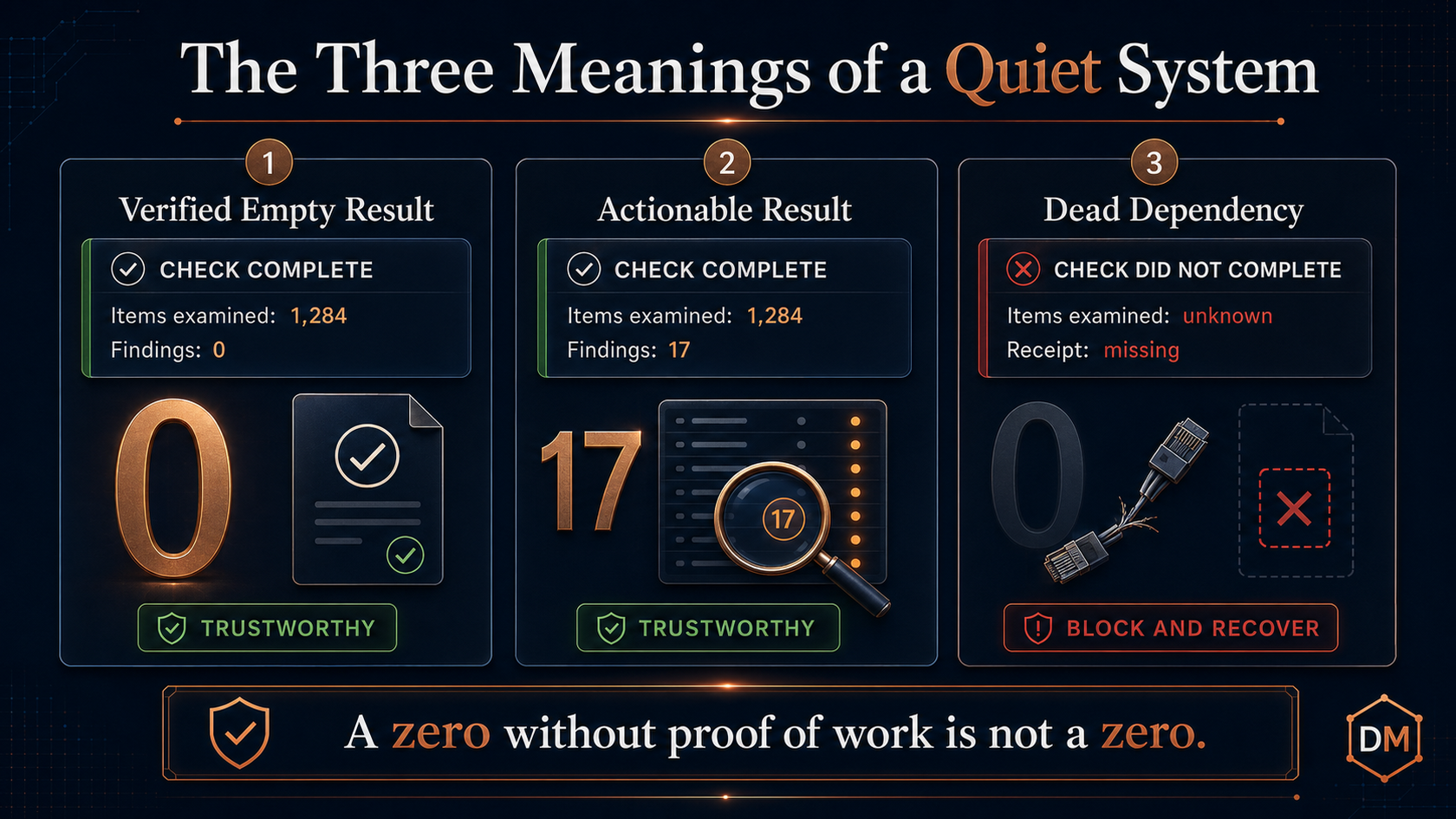
Notice what these have in common. No model was wrong. No prompt needed tuning. Each failure lived in a seam between components, and each seam was unowned. The zero arrived with no evidence that the work behind it had actually happened, and no person or mechanism was accountable for demanding that evidence.
The missing boundary
The fix is not intelligence. It is a boundary with rules, owned by someone, enforced by machinery.
In my systems that boundary now has a consistent shape. Every report of "nothing to do" must carry proof that the check ran: a receipt, a count of what was examined, a heartbeat with an activity denominator. Every gate fails closed: when evidence is missing, the answer is no, the action does not fire, and a human gets a specific, named reason. Every system reading a check distinguishes three states, not two: a result, a verified empty result, and no answer. Collapsing the third state into the second is the root of the false zero, so my gates refuse to collapse it.
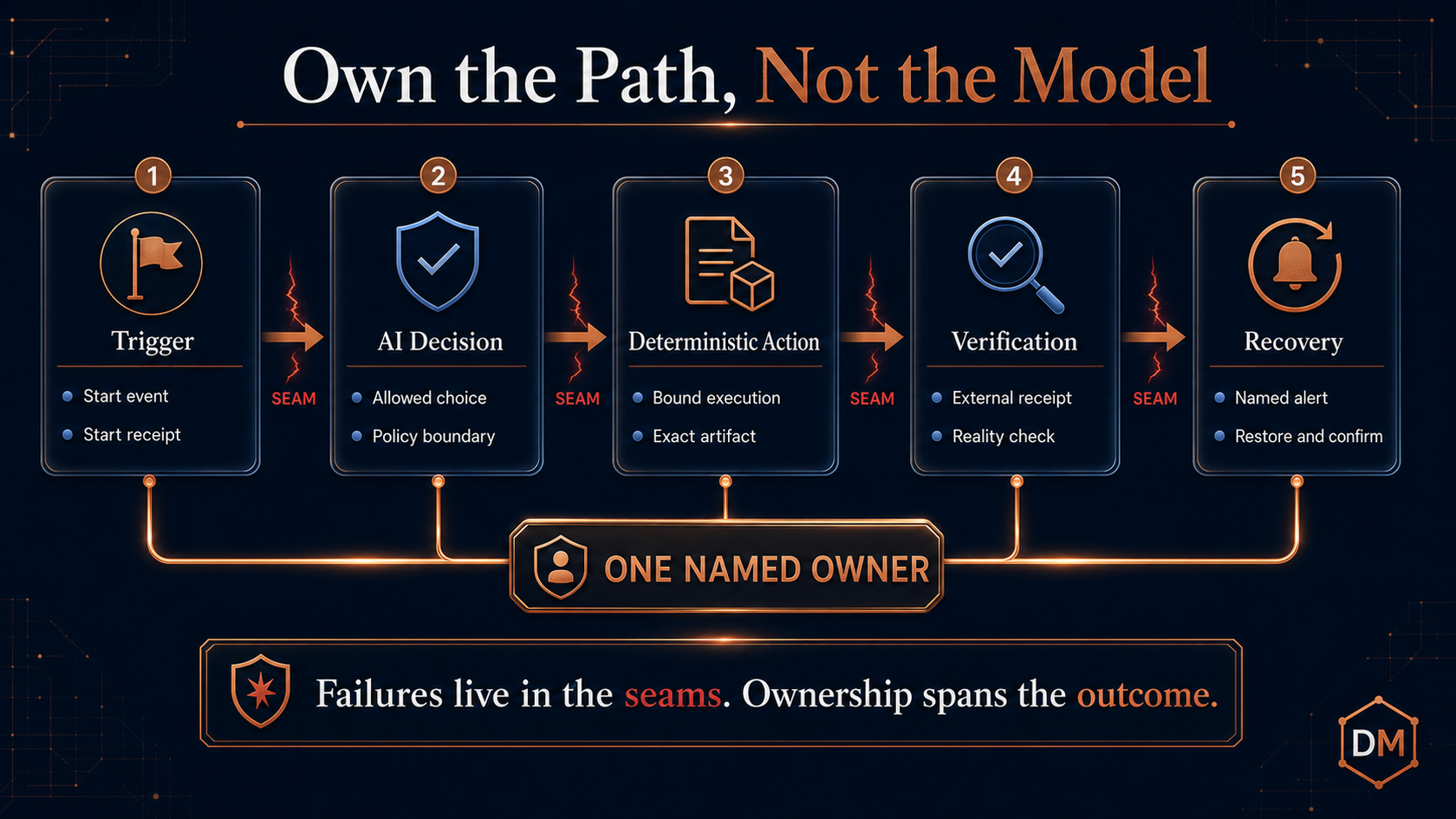
And every workflow has an owner. Not an owner of the model. An owner of the path: the trigger that starts it, the decision the AI is allowed to make, the deterministic steps it is not allowed to touch, the verification that proves the outcome, and the recovery when verification fails.
The operator test
You do not need to read code to find out whether you have this problem. Ask three questions in your next operations meeting.
If the data feed behind our AI workflow died right now, what would tomorrow's report show? If the honest answer is "a normal-looking quiet day," you have a false zero waiting.
Who is the named person who would notice within a day, and what exactly would they see? "The team would probably catch it" means nobody owns it.
When the system says nothing needed doing, what evidence does it attach that the check actually ran? If the answer is none, your reports are claims, not evidence.
I have watched what happens when these questions go unasked, in my own operation. A messaging gateway of mine once looked alive while every inbound message died quietly in a retry loop inside it, until a human happened to notice. In another case, an incident was closed because the root cause was fixed, while the systems the outage had knocked over stayed down for twelve days, five of them after the closure. The alarm that would have caught it had been retired because the thing it watched was gone. Closure tracked the mechanism. Nobody owned the outcome.
What ownership actually means
When I say ownership, I mean a person and a mechanism, together, accountable for five specific things.
What starts the workflow, and what proves the start happened. What the AI may decide alone, written down, with everything else deterministic by default. What action results, and what receipt the outside world returns to prove it. What check verifies the outcome against reality rather than against the system's own belief about itself. And what happens on the day evidence is missing: who is paged, what fails closed, what gets restored, and who confirms the restoration actually happened rather than assuming the fix reached the victims.
Teams that can answer those five questions have a much stronger basis for operating AI reliably. Teams that cannot will keep running impressive pilots that stall, and they will keep blaming the model, because the model is the only component with a name.
The uncomfortable truth underneath all of this is also the liberating one. Workflow ownership is not a research problem. It does not require a smarter model, a bigger budget, or a platform migration. It requires deciding that silence is not evidence, that zeros must prove themselves, and that one named person owns each path from trigger to verified outcome. All three of the failures I walked through were fixed quickly once they had an owner, and none of the fixes involved touching a model.
Your AI is probably fine. Go find out who owns the zero.