Why Most AI Governance Starts Too Late
Observability makes AI systems legible; only pre-execution authority evaluation makes them governable.
Policies, dashboards, and audit logs make AI systems observable. They do not make them governable. Once an agent can change state, governance has to stop the action before the mutation - not explain it afterward.
Most AI governance starts after the action.
A model selects a tool. An agent executes a workflow. A database is updated. A message is sent. A file crosses a permission boundary. A business process advances.
Then the system logs it. Then a monitor evaluates it. Then a dashboard reports it. Then a human reviewer decides whether the action should have happened.
This is not governance. It is after-action accounting.
The distinction matters because the systems now being deployed into enterprises are no longer passive prediction services. They are execution systems. They call tools, move data, update records, trigger workflows, produce decisions, and operate across persistent context.
When an AI system can mutate state, the decisive question is not whether the organization can explain what happened afterward. The decisive question is whether the system could have been stopped before the state changed.
Most AI governance architectures answer that question too late. This article argues for moving the control point - from after-action review to pre-execution authority - and lays out what that shift requires in practice: where enforcement has to sit, what artifact it has to produce, and how to test whether a given architecture actually governs or merely observes.
The category error
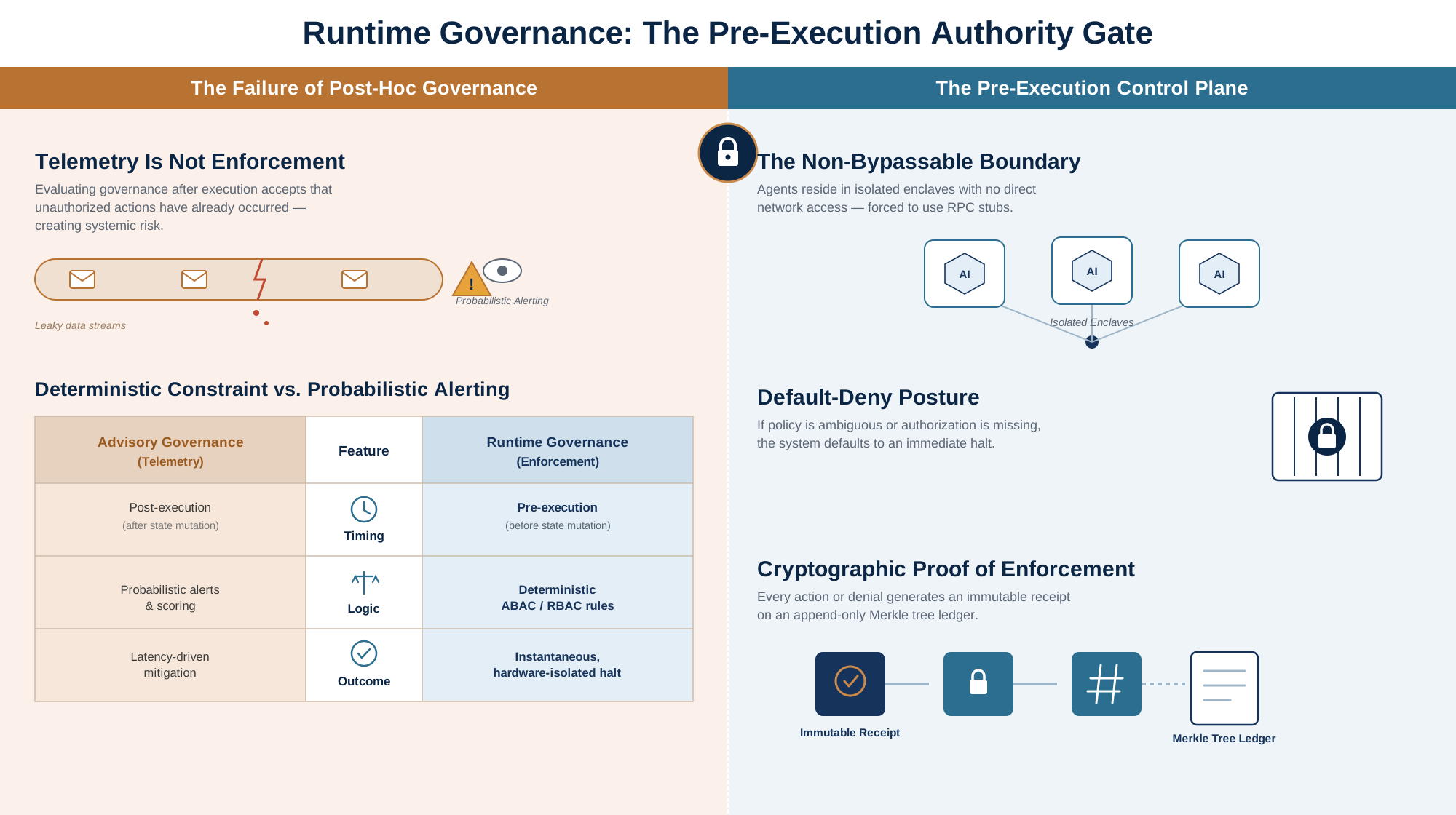
Many organizations still treat AI governance as an organizational layer. They create policies, define responsible-AI principles, assign risk owners, build dashboards, add logging, monitor outputs, run evaluations, and create escalation paths.
These controls are useful. They are not sufficient.
The category error is treating governance as a visibility problem when the actual failure mode is an execution-control problem. Visibility answers a retrospective question - what happened? Governance has to answer a different one - what is allowed to proceed? Those are not the same system.
A log records an event. A dashboard visualizes an event. An alert reacts to an event. A policy document describes intended behavior. An evaluation estimates behavior under test conditions. None of those mechanisms, by themselves, prevents a disallowed action from completing. They observe, classify, and inform. They do not govern.
Governance begins when execution depends on authority.
State mutation changes the problem
The traditional model-risk frame assumed a relatively contained system. A model generated a score. A human interpreted the score. A downstream system acted separately. Validation could occur periodically, and governance could sit around the model.
That assumption breaks when AI systems become agents. An agent does not merely produce an output. It forms an intent, chooses a tool, passes parameters, invokes an API, retrieves context, writes data, and continues operating. The risk is no longer whether the model's answer was accurate. The risk is whether the system can perform an unauthorized action.
A state mutation is any durable or externally consequential change made by the system - a database update, a payment instruction, a CRM change, a permission change, a document transfer, a message sent to a customer, a workflow approval. Once the mutation completes, governance is downstream. At that point the system is no longer deciding whether the action should occur; it is deciding how to explain, remediate, or document the action that already occurred. That is a fundamentally different control problem.
The problem with post-hoc governance
Post-hoc governance accepts a dangerous premise: that unauthorized action may occur before intervention. This premise is often hidden inside otherwise reasonable architecture - the system executes, the log records, the monitor detects, the alert fires, the reviewer investigates, the organization remediates.
That sequence can support incident response. It cannot serve as the primary enforcement model for high-risk AI execution, because the latency is the failure:
If an AI workflow sends regulated data to the wrong endpoint, the alert does not undo disclosure.
If an agent modifies a production record, the log does not prevent the mutation.
If a system approves an action outside policy, the dashboard does not restore authority.
If a tool invocation uses authorized credentials with unauthorized parameters, post-hoc review does not change the fact that the system was allowed to act.
Governance evaluated after execution is telemetry. Telemetry is not enforcement.
The missing unit is the execution boundary
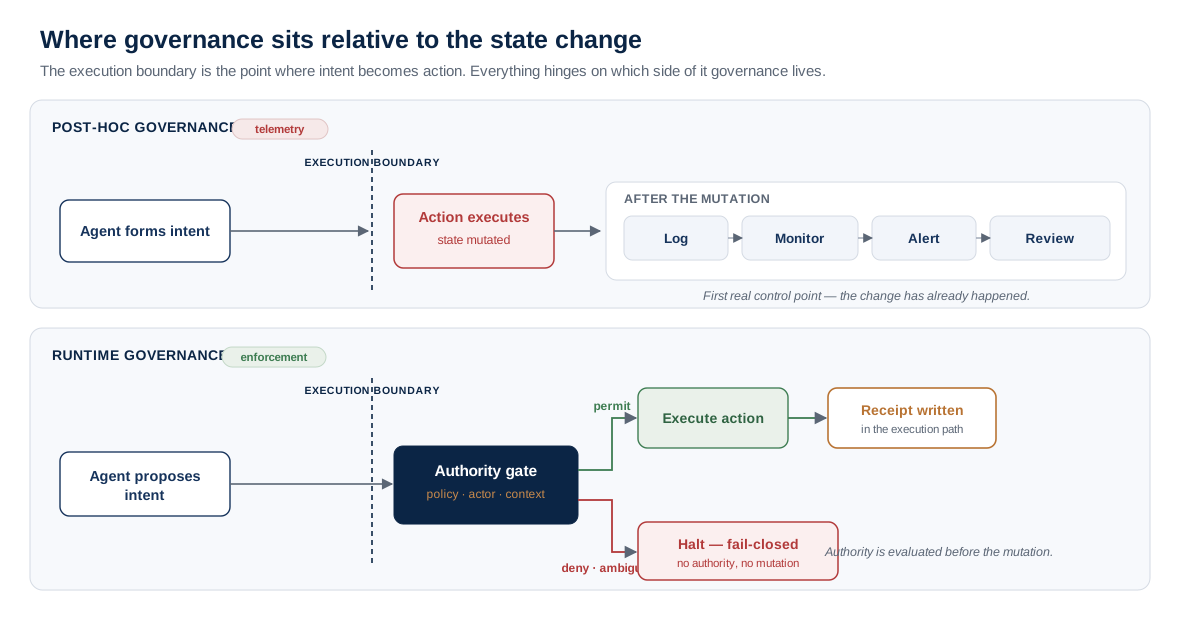
The central unit of AI governance is not the model, the prompt, the policy document, or the dashboard. It is the execution boundary - the point where intent becomes action.
Before that boundary, the system can reason, propose, retrieve, rank, summarize, or plan. After that boundary, the system changes something. Governance has to sit at that boundary - not near it, not parallel to it, not downstream from it.
At the execution boundary, the system must answer a small set of deterministic questions before the action proceeds:
What is the system trying to do?
Who or what authorized it?
Which policy applies?
Is the requested action inside scope?
Are the parameters authorized?
Is the current context still valid?
What evidence proves the decision?
What happens if the answer is ambiguous?
If the system cannot answer those questions before mutation, it is not governing execution - it is letting execution run ahead of governance. That is the structural failure.
Authority must be evaluated before mutation
Authority is not the same thing as capability. A system may be capable of calling an API; that does not mean it is authorized to call it. A system may be capable of sending an email; that does not mean it is authorized to send this email, to this recipient, with this content. A system may be capable of updating a record; that does not mean it is authorized to update this field, in this account, under this workflow, at this time.
Most AI systems collapse capability and authority. They grant tools to the agent and rely on prompts, policies, or application logic to keep behavior inside bounds. That is weak architecture. The model should not be the enforcement layer for its own behavior.
A governed system separates intent generation from execution authority. The AI system can propose an action. A control plane decides whether the action can proceed:
intent = agent.propose_action(context)

decision = authority_gate.evaluate(
    intent=intent,
    policy=active_policy,
    actor=session_identity,
    context=current_context,
)

receipt = receipt_ledger.write(
    intent=intent,
    decision=decision,
    policy_version=active_policy.version,
    actor=session_identity,
)

if decision != "permit":
    halt_execution(receipt)
else:
    execute_action(intent, receipt)
The important detail is not the syntax. It is the sequence. The action does not execute first. The log does not arrive later. The reviewer does not become the first real control point. Authority is evaluated before mutation, a receipt is created as part of the execution path, and ambiguity halts the transaction. Execution depends on governance.
Fail-open is the default failure mode
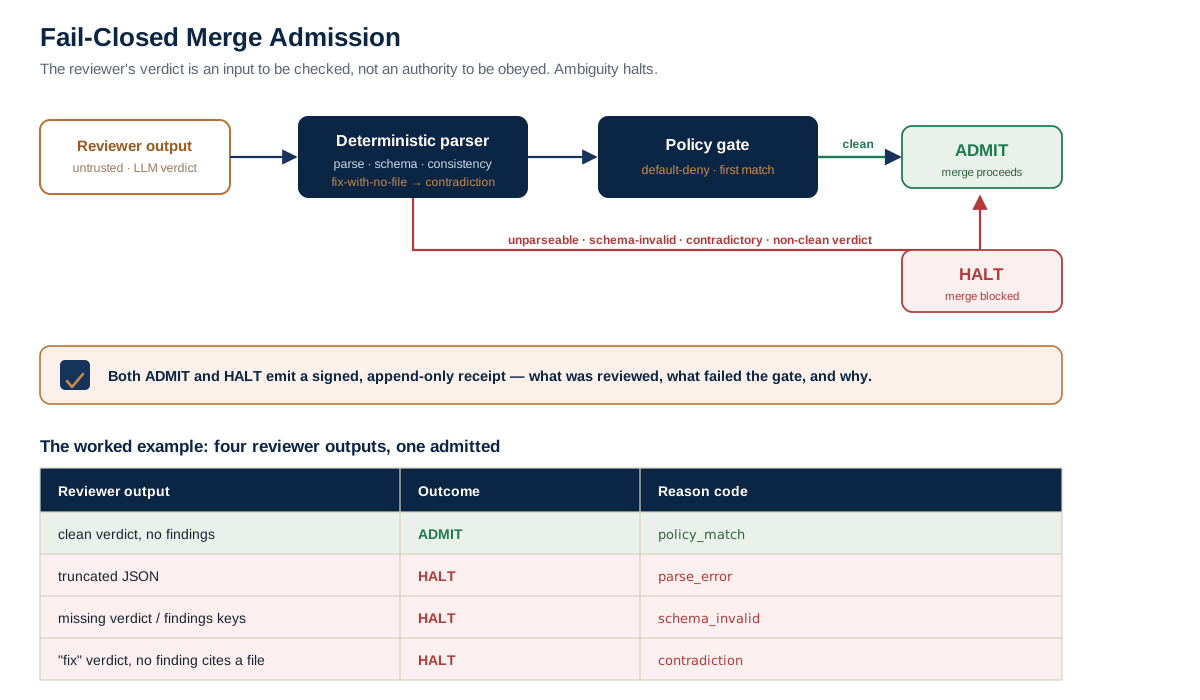
Many systems fail open without saying so. A policy service times out, so the workflow proceeds. A classifier returns an uncertain score, so the action routes anyway. A guardrail fails to parse the response, so the application retries. A logging service is unavailable, so the transaction completes without evidence. A human approval step is skipped because the system treats it as asynchronous.
These are not operational edge cases. They are governance failures.
A governed system must fail closed. Fail-closed means execution halts when authority cannot be verified, when policy cannot be resolved, when context is incomplete, when the requested parameters exceed scope, or when the evidence artifact cannot be written.
This is uncomfortable for product teams, because fail-closed systems interrupt workflows. That interruption is the point. Governance that cannot stop execution is advisory. It may be useful, informative, even necessary for audit review - but it is not enforcement.
Logs are not receipts
Audit logs are often treated as proof of governance. They are not. Logs are observational artifacts: they record that something happened. Receipts are enforcement artifacts: they prove that a specific action was evaluated under a specific policy, by a specific authority, at a specific time, before execution proceeded.
The distinction is mechanical. A log can be written after the fact; a receipt must be generated in the transaction path. A log can describe an event; a receipt binds the authority decision to the mutation. A log supports investigation; a receipt supports non-repudiation.
A log says: this happened. A receipt says: this was authorized, under this policy, by this authority, before it happened.
For AI systems that mutate state, this distinction determines whether the organization holds audit-grade evidence or merely operational telemetry. If a mutation can complete without a receipt, it can complete without governance.
Evals are not control planes
Evaluations are useful. They measure model behavior under defined conditions, and they help teams compare systems, detect regressions, test prompts, and assess risk before deployment. Frameworks like NIST's AI Risk Management Framework formalize this organizational discipline, and reporting conventions such as model cards make a system's intended use and limitations legible [1][2].
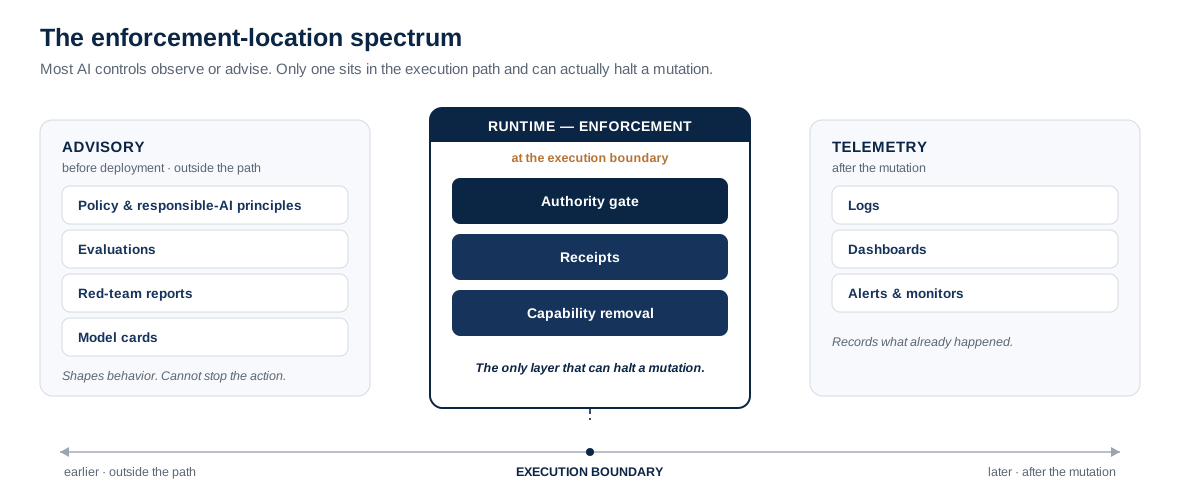
But an eval is not a runtime control plane. An eval does not authorize a specific action, inspect every tool invocation, bind policy to a transaction, halt execution when authority is missing, or prove that a state mutation was permitted before it occurred. The same is true for red-team reports, policy reviews, benchmark scores, and model cards. They contribute to governance; they do not replace enforcement.
A system can pass evaluations and still execute an unauthorized action in production. This happens because production execution contains variables that test environments cannot fully capture: live context, changing permissions, tool parameters, user-specific state, workflow timing, data dependencies, and long-running agent behavior. The governance layer must operate where those variables exist. That means runtime.
Guardrails are not enough when capability remains
Guardrails often sit at the model or application layer. They filter prompts, classify outputs, block certain content, detect policy violations, and shape behavior. These mechanisms are useful for many classes of risk. They are not sufficient for state-mutating workflows when the underlying capability remains available.
If an agent has network access, credentials, tool access, and a route to production systems, the organization is relying on the agent not to misuse capabilities it already possesses. That is restriction - the capability exists but is blocked by a rule.
Capability removal is different. It means the execution environment does not possess the primitive required to perform the unauthorized action: no direct network route, no persistent credential, no raw socket access, no production database path, no tool invocation outside a mediated boundary. A system cannot misuse a capability it does not have.
This is why substrate design matters. The execution environment should be treated as untrusted compute. It should not be able to route itself around governance. The agent can produce intent; it should not independently possess the authority, credentials, and network pathways required to turn that intent into production state.
Drift is a governance problem across time
AI systems do not only fail at a single transaction. They fail over time. A workflow that behaved correctly on Monday can become unsafe by Friday because context changed, permissions changed, memory accumulated, prompts shifted, tools changed, or the model began operating near guardrail boundaries.
Per-action authority checks are necessary, but not sufficient alone. Governance must also constrain behavior across time - not as passive monitoring, but as enforceable containment. Increasing guardrail triggers, repeated near-denials, escalation loops, changes in tool-use frequency, semantic drift in task execution, and the width of authority windows all matter.
A system that had authority yesterday does not automatically have authority tomorrow. Authority should decay. Execution paths should not remain open indefinitely. Long-running AI systems require temporal constraints because risk compounds across sequences, not only individual actions. Monitoring watches that sequence; governance intervenes in it.
The three-question audit
Any AI governance architecture can be tested with three questions.
1. Where does enforcement occur? If enforcement occurs after execution, it is telemetry. If it occurs outside the execution path, it is advisory. If it occurs inside the transaction path before mutation, it can govern. The location of enforcement determines whether the system can stop the action.
2. What happens on failure? If policy cannot be resolved, does execution proceed or halt? If the authority service is unavailable, does the workflow continue? If the parameters are ambiguous, does the system route anyway? If the receipt ledger cannot commit, does the mutation still complete? The failure path reveals the real governance model: a system that proceeds under ambiguity is fail-open; a system that halts under ambiguity is fail-closed.
3. What artifact proves enforcement? A dashboard is not proof. A policy document is not proof. A model evaluation is not proof. An application log is not enough. The artifact must show what action was requested, what policy was evaluated, who or what authorized it, what decision was made, when it occurred, and whether execution was permitted or denied. Without that artifact, enforcement is inferred - and inferred enforcement is not audit defensibility.
What better AI governance looks like
A governed AI execution system has a different shape. The model does not directly mutate production state. The agent does not hold standing authority. The execution environment does not contain unnecessary capability. Tool calls are mediated through an enforcement boundary. Every state-mutating action is represented as a structured intent. Policy is evaluated deterministically before execution. Ambiguity defaults to denial. Material actions generate receipts. Behavior is constrained across time. Substrate access is limited by physical and infrastructural boundaries, not only model instructions.
This architecture does not eliminate AI risk. It changes where risk is handled. Instead of discovering unauthorized behavior after mutation, the system constrains execution before mutation. Instead of relying on logs to reconstruct events, it produces receipts as part of the execution path. Instead of trusting the model to obey policy, it places policy outside the model and inside the control plane. Instead of allowing capability and hoping it is not misused, it removes unnecessary capability from the execution environment.
This is the shift from advisory governance to runtime governance.
The practical boundary
Not every AI interaction requires the same level of enforcement. A summarization assistant reading public documentation does not need the same controls as an agent that can approve refunds, modify customer records, change permissions, execute trades, or move regulated data.
The boundary is state mutation. When AI produces text that a human can ignore, governance can be lighter. When AI changes external state, governance must be structural. The higher the blast radius, the less acceptable post-hoc governance becomes. For low-risk workflows, observation may be enough. For consequential workflows, execution must depend on authority. That is the practical line.
Governance has to move earlier
Most AI governance starts too late because it was built around the wrong operating model - one that assumes AI systems are things to be evaluated, monitored, and reviewed. That was adequate when AI systems produced recommendations. It is inadequate when AI systems execute.
Execution changes the control surface. Once an AI system can mutate state, governance has to move from policy documentation to execution architecture, from dashboards to transaction boundaries, from logs to receipts, from after-action review to pre-execution authority.
The question is not whether the organization has AI governance. The question is whether governance can stop the system before the state changes. If the answer is no, governance starts too late. And if governance starts after mutation, it is not governance. It is hope.
Dan Mercede is a systems architect focused on governed automation and runtime enforcement for enterprise AI. He writes about fail-closed system design, control planes, and the architecture of human-owned intelligence.
References
[1] M. Mitchell, S. Wu, A. Zaldivar, P. Barnes, L. Vasserman, B. Hutchinson, E. Spitzer, I. D. Raji and T. Gebru, Model Cards for Model Reporting (2019), Proceedings of the Conference on Fairness, Accountability, and Transparency (FAT* '19)
[2] National Institute of Standards and Technology, Artificial Intelligence Risk Management Framework (AI RMF 1.0) (2023), NIST AI 100-1